|
Our current dog truck is a traditional style dog
truck, with dog boxes above the bed.
We haven't always had a traditional dog truck, with
our previous two dog vehicles being a 1998 Ford Expedition
and 2004 VW Jetta Wagon. Initially, we liked transporting
the dogs loose in the vehicle since it allowed the
dogs to pick their spaces. We recently decided to
make individual internal dog boxes. One reason for
the dog boxes was to make it easier at events since
we could release individual dogs. A second reason
was for safety. Dog boxes allow the dogs to be securely
fastened and allow each dog their own private area.
Most dog boxes are built on pick up truck beds -
and for good reason. With a pick up truck bed, there
are more straight sizes and there are fewer constraints
on the dimensions of the dog boxes. We found out how
much easier it was to build traditional dog boxes
with our current truck. With a full size or mini-van,
the floor is much lower, making it easier to fit the
required boxes. With a full sized SUV such as the
Expedition, the rear air conditioning, lift gate framework
and general shape of the interior intrude. In addition,
we wanted to be able to raise the rear seats if required
to transport people or equipment.
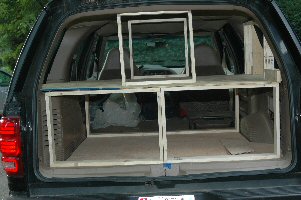
We designed our boxes based on Mush with Pride guidelines.
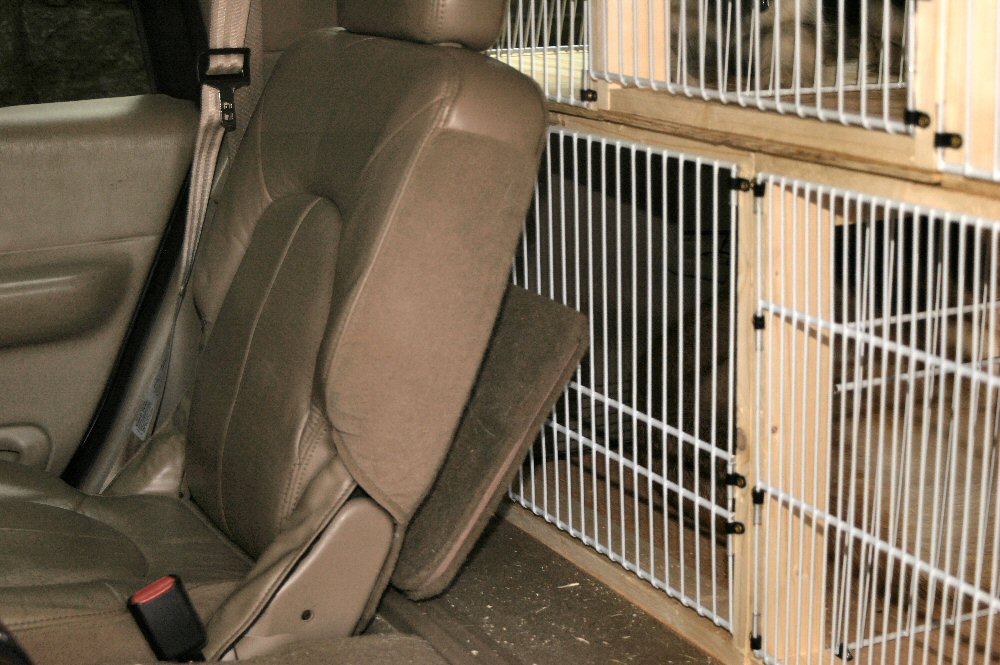
We decided to make the boxes so they could be opened
either to the outside or inside of the vehicle. We
transport our Fritz Dyck rigs on an external rig carrier,
which limits which direction the dogs can be loaded
or unloaded with the rig carrier in place.
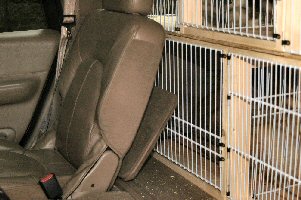
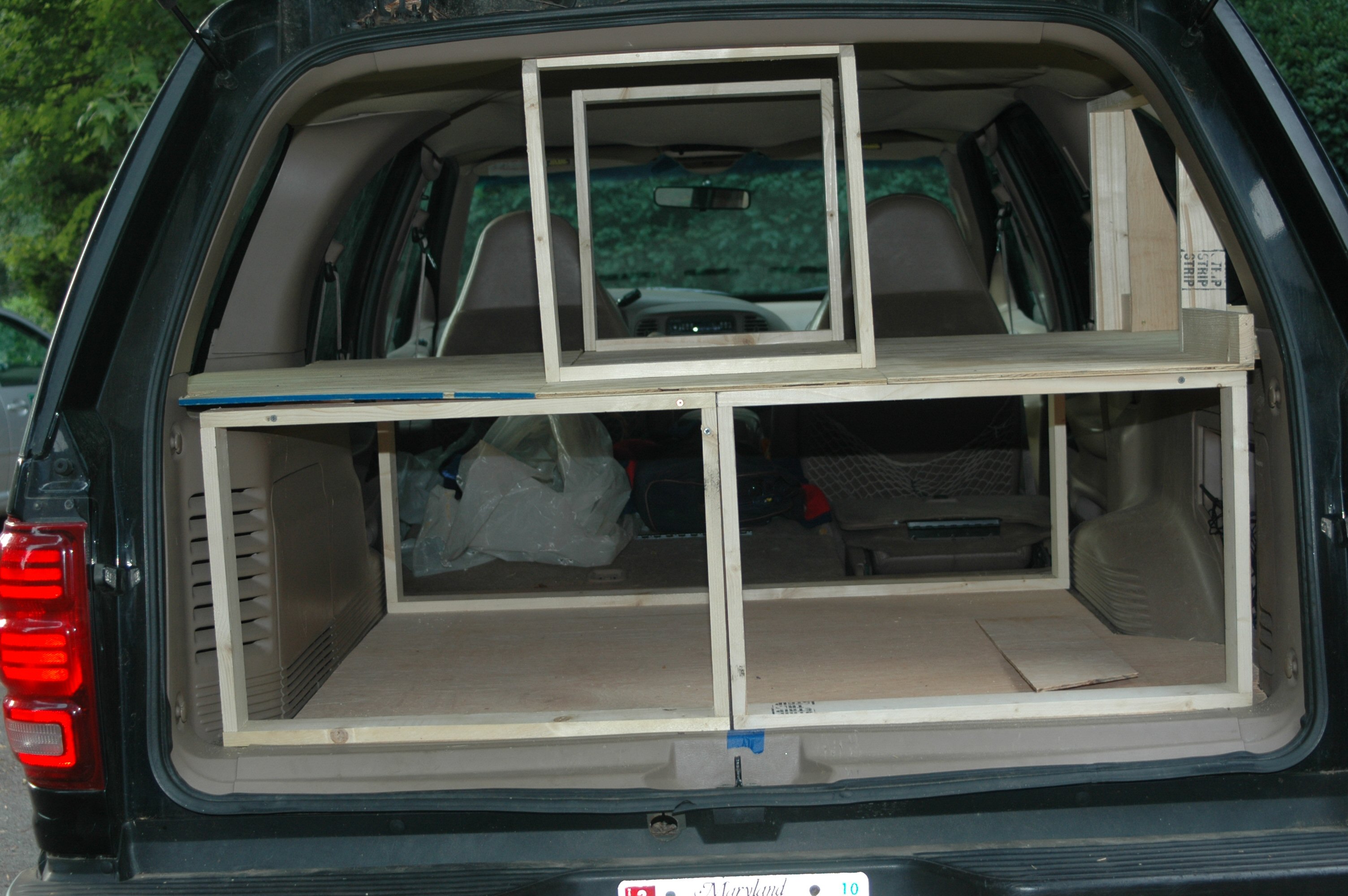
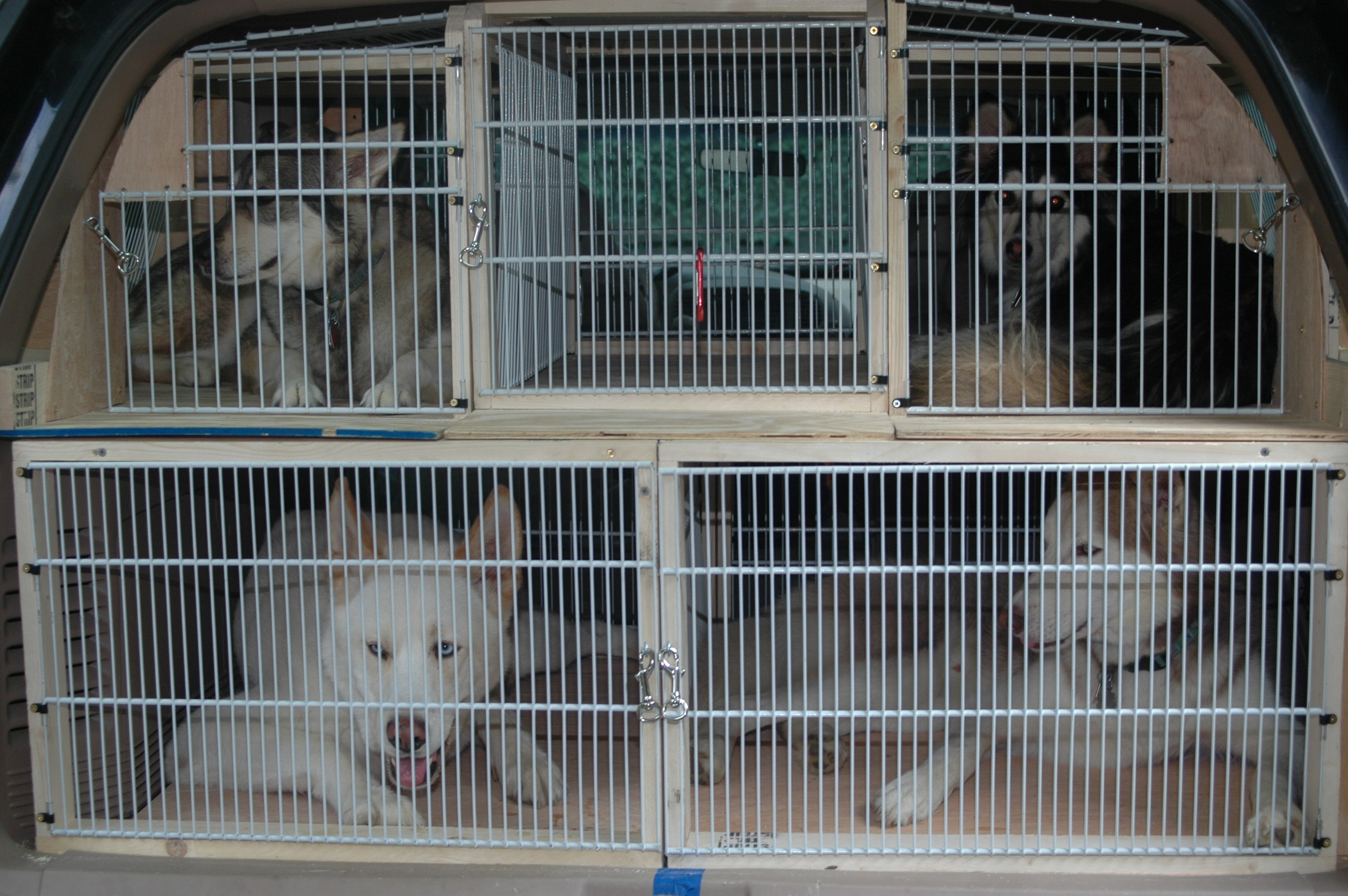
The two larger dogs (Okemo and Sobo) each had their
own dog box on the lower level. T-Bone and Zoë
each had their own dog box on the upper level, complete
with a "bay window" and view. Acadia, then
the youngest puppy, had the smallest box in the center
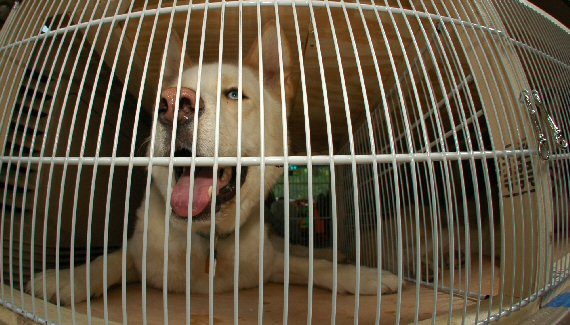
of the upper level. The bay window basically fills
into the rear windows on the truck and allows the
upper boxes to be larger. There is a set of wire grills
between the dog area and the window.
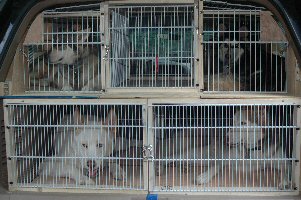
We built the boxes as light as possible. The floor
between the upper boxes and lower boxes is made from
1/4" plywood and 1" x 3" framing supports.
Wire shelving was used for the doors and sides of
the boxes to allow good ventilation and reduce weight.
Wire cable clamps were used as hinges for the doors.
One of our concerns was sealing the wood to prevent
damage from accidents, wet paws and similar. We used
West Epoxy to seal the floors of the dog boxes. Acadia's
box had a boot tray bottom, which gives good security
against accidents and can be easily removed. The other
boxes had bath tub mats on the floor to contain dirt
and moisture.
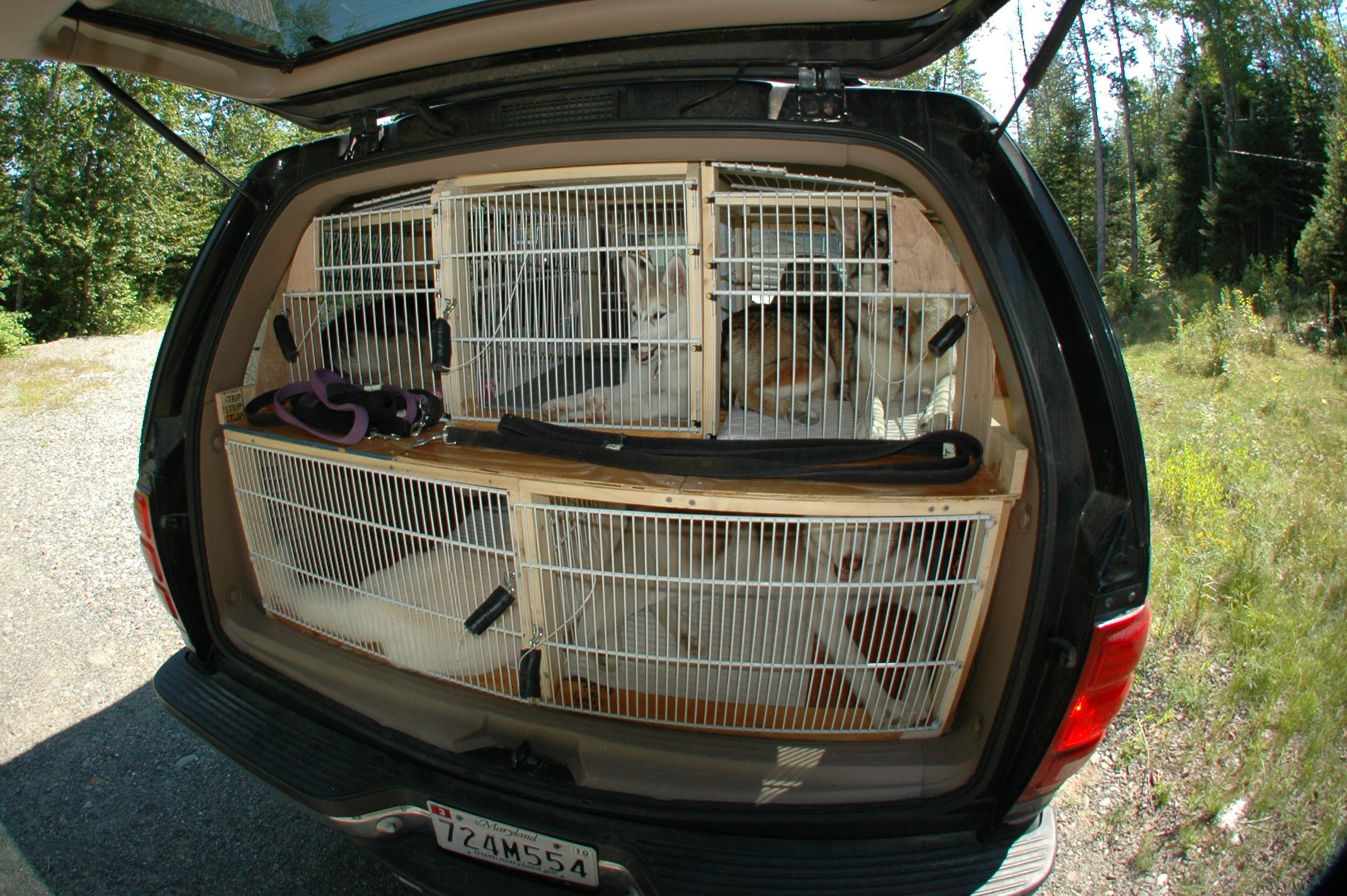
The upper boxes are shorter than the rear boxes.
The rear lift gate has a bit of a forward cant to
it, which forced the upper boxes to be shorter. Since
the upper boxes are shorter, there is a short shelf
that can be used to store leashes and other items.
The boxes worked relatively well. Okemo and Sobo
both happily jumped into their boxes (something they
can't do in a traditional truck that requires each
dog to be lifted into their boxes). The upper level
dogs need to be lifted into their boxes or can crawl
in through the passenger compartment. We really liked
the boot tray floor for Acadia's box, but it would
be tough to find one to fit the other four boxes since
their shapes are relatively unusual.
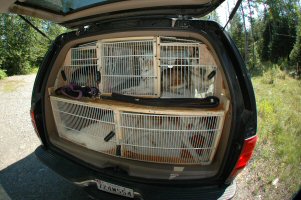
The boxes were relatively time intensive to build
and required considerable trial and error cutting
to obtain a satisfactory fit. |